
The AA: Abi, a Roadside Assistance Assistant
A conversational assistant on the phone for drivers who have broken down: it confirms where they are, checks they are safe, dispatches a patrol with a live arrival time, and offers safety advice while they wait. A proof of concept shown to the AA.
Duration
2017 to 2018
Team
1
Scale
POC
Scope
United Kingdom
Overview
Breaking down is stressful. The driver is often on an unfamiliar road, unsure exactly where they are, and anxious about traffic. Abi was a digital assistant for the AA that turned the call for help into a short conversation on the phone, typed or spoken: confirm the location, check the driver is safe, get a patrol moving, and keep them informed until it arrives. I designed the concept, the conversation and the demo.
Challenge
A stranded driver has to describe where they are, which is hard when they do not know the road.
Safety comes first, but a phone call can spend its first minutes on account details.
Once help is on the way, the driver wants to know when it will arrive and what to do meanwhile.
Strategy
The objective: get help moving within the first minute, without the driver needing to know exactly where they are.
Why now: conversational AI and phone location had made it practical to handle a breakdown report in a natural conversation rather than a call queue or a form.
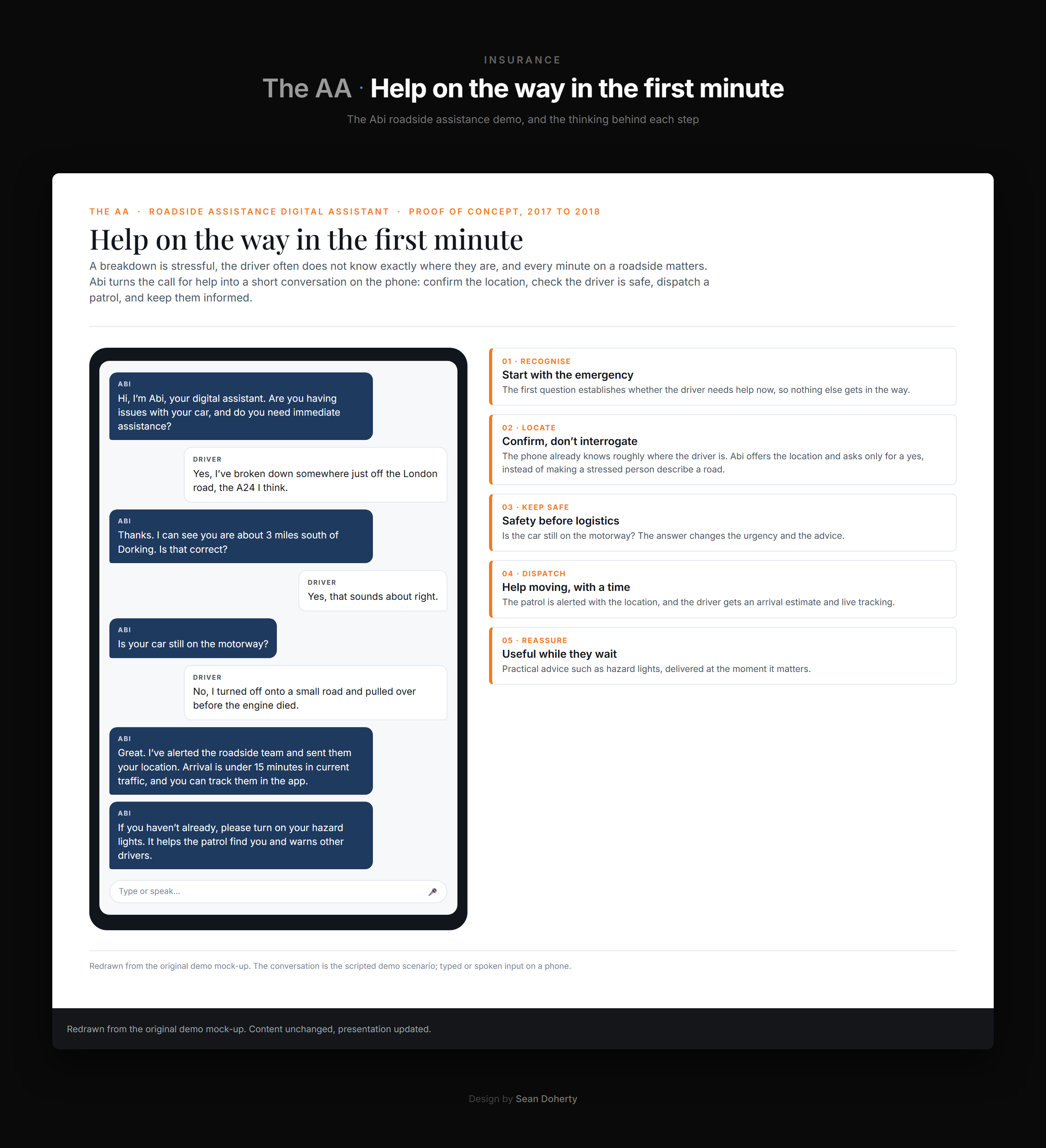
The strategic choices: start with the emergency, so the first question is whether help is needed now. Let the phone's location do the work: Abi offers where it thinks the driver is and asks only for a yes, instead of making a stressed person describe a road. Put safety before logistics ("Is your car still on the motorway?"). Give an arrival time and live tracking, and use the wait to offer practical advice such as turning on the hazard lights.
How success was measured: time from first message to a patrol dispatched, and how informed and safe drivers felt while waiting.
The demo
The working demo, recorded in 2018, walks one driver, Nicky, through the whole journey:
Report: Abi asks whether she needs immediate help, confirms her location from the phone ("about 3 miles south of Dorking, is that correct?"), checks she is off the motorway, dispatches a patrol with an arrival time and live tracking, and reminds her about her hazard lights.
Triage: Abi confirms the car from her records ("a 2003 Toyota Avensis, is this the car you are in now?"), asks what happened "in a few short words", and whether any warning lights came on, so the patrol arrives knowing more.
Safety: Abi asks if she has a reflective jacket and advises putting it on, getting out on the side away from traffic and standing behind a barrier.
Empathy: when Nicky says "it's very dark here, there are no lights", Abi changes its advice to stay in the vehicle, gives an updated arrival time, and offers a live agent.
Using the wait: Abi confirms her details while the patrol is on its way, then passes the instructions to the team.
Follow-up: after the repair, Abi checks in: "I see they were able to fix your problem and you have arrived home. Please let me know if there is anything else I can do."
Status
Innovation concept and proof-of-concept demo, in development in 2017 and shown to the AA in its 2018 innovation workshops. It was not taken further.
Project Artifacts
Project Details
Industry
Insurance
Duration
2017 to 2018
Team Size
1
Direct Reports
0
Scale
POC
Scope
United Kingdom
Budget
Undisclosed
Platforms
Mobile app, conversational AI (typed and spoken)
Regulatory
Moderate
Engagement
Innovation concept and proof-of-concept demo