
HMRC
Virtual world concept developed for an HMRC Innovation Day — a fully navigable virtual office with lobby, training rooms, and lounge, accessible via VR headsets, desktop, tablet, and mobile in both 3D and 2D modes.
Duration
1.5m
Team
1
Scale
POC
Scope
United Kingdom
Overview
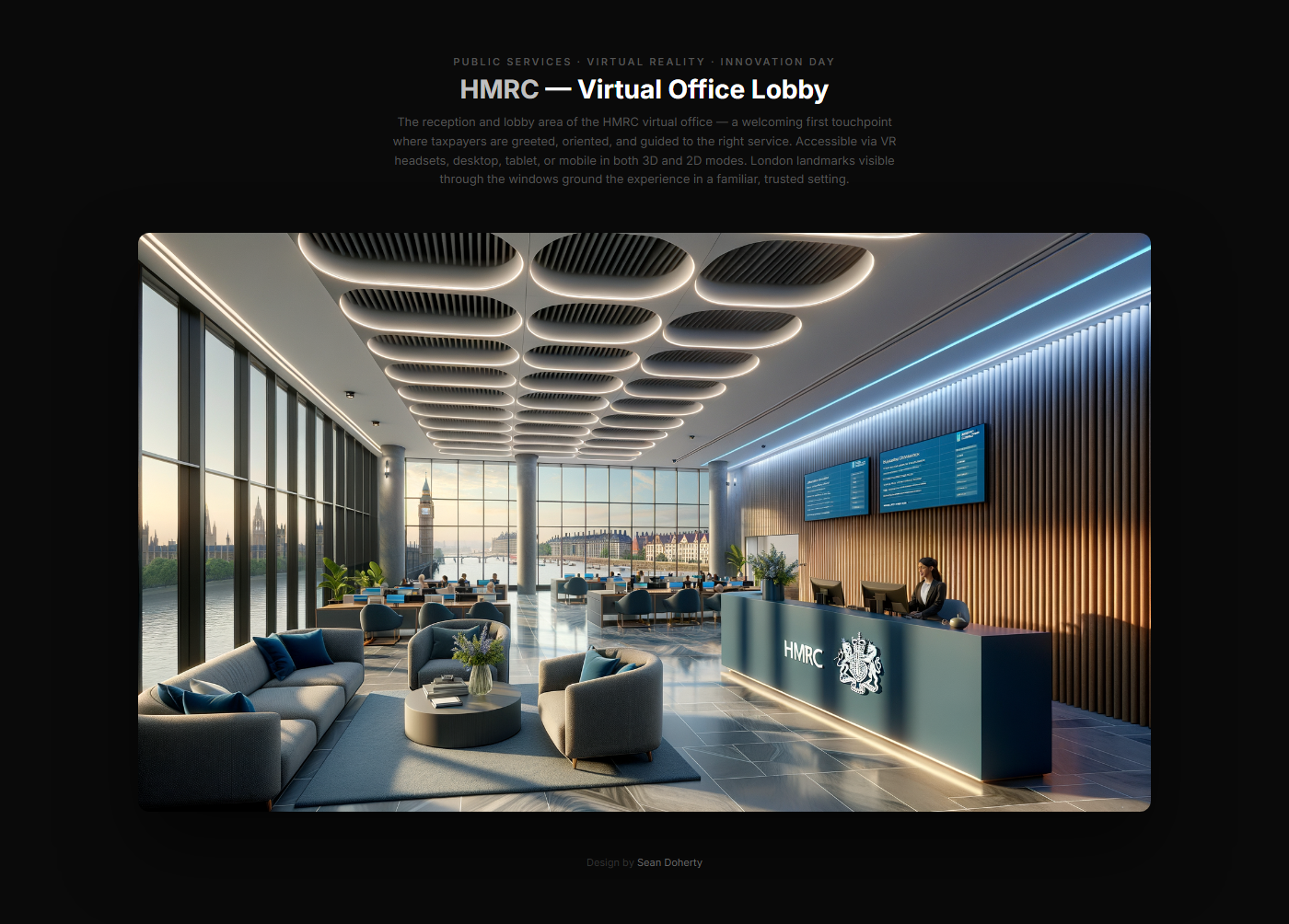
Developed for an HMRC Innovation Day — immediately before the Covid pandemic — this concept demonstrated how virtual world technology could transform public service delivery. The virtual HMRC office is a fully navigable environment featuring a welcoming lobby, interactive training rooms, and a comfortable lounge — all set against London landmarks visible through the windows, grounding the digital experience in a familiar, trusted setting.
Critically, the solution was designed to work across every device class: fully immersive 3D via VR headsets (Oculus, HTC Vive), navigable 3D on desktop and tablet browsers, and a simplified 2D mode on mobile phones — ensuring no citizen was excluded regardless of their technology access.
Challenge
HMRC's traditional service channels — phone queues, paper forms, and in-person appointments — created barriers for millions of taxpayers, particularly those with accessibility needs or limited mobility.
Self-assessment filing remained a source of confusion and anxiety for many citizens, leading to late submissions and increased support call volumes.
Innovation Day required a compelling, tangible demonstration that virtual world technology was not science fiction but a practical, accessible, near-term solution for public services.
Research & Discovery
Studied taxpayer pain points through existing HMRC user research, identifying the self-assessment process, finding the right guidance, and waiting for support as the primary friction areas.
Researched cross-platform VR delivery to ensure the concept could demonstrate accessibility across VR headsets, browsers, tablets, and phones — a key requirement for a public service reaching all demographics.
Analysed London-based government office environments to inform the virtual world's architectural design, ensuring it felt authentically HMRC rather than generic.
Solution & Deliverables
A welcoming virtual reception lobby where citizens are greeted, oriented, and routed to the right service — with panoramic London views through floor-to-ceiling windows establishing trust and familiarity.
An interactive training room for guided self-assessment tutorials, tax return walkthroughs, and live support sessions — with presentation screens, workstations, and direct access to HMRC guidance.
A relaxed sitting area and lounge for browsing tax guides, waiting for assistance, or connecting with live agents — designed to feel approachable rather than bureaucratic.
Full 3D immersion via VR headsets, interactive 3D navigation via desktop and tablet browsers, and a streamlined 2D experience for mobile phones.
Results & Impact
The Innovation Day demonstration showed HMRC leadership a tangible, working vision for how virtual worlds could reduce call centre volume, improve taxpayer confidence, and make government services more accessible.
The cross-platform approach proved that VR-powered public services could reach every citizen — from tech-savvy early adopters with headsets to elderly taxpayers on basic smartphones.
The timing, immediately pre-Covid, proved prescient — within weeks, the entire country would shift to remote service delivery, validating the exact use case this concept addressed.
Project Artifacts
Project Details
Industry
Public Services
Duration
1.5m
Team Size
1
Direct Reports
0
Scale
POC
Scope
United Kingdom
Budget
<5K
Platforms
VR Headsets, Web (3D & 2D), Tablet, Mobile
Regulatory
Heavy
Engagement
Innovation Day Concept