
Connected Journey, 2026 Architecture
The connected customer idea rebuilt for agentic AI: one assistant that knows the trip, books parking, fast track, lounges and order-ahead, and times each one to the live terminal, with MCP as the integration layer and payments kept out of the model's hands.
Duration
2026
Team
1
Scale
Concept
Scope
Global
Overview
In 2019 I presented a connected customer concept to four UK airports: reach passengers while they plan, earn from services they choose, and guide them through the terminal. Seven years on, nobody has joined it up. The pieces exist separately: airport parking and timed security lanes sold online, AI assistants at information desks, order-ahead in a few terminals, retail media networks. In 2026 I set out how I would build it now that AI agents can act on a traveller's behalf.
Challenge
A traveller books parking, fast track, a lounge and food from different companies, one at a time, and often at the last minute.
Each supplier knows its own booking; none knows the trip, the queue or the gate change.
A single airport's app is used twice a year, so it rarely earns a place on the phone.
General AI assistants already read travellers' email, but know nothing about the terminal.
Strategy
The objective: one assistant that books everything around a trip in a single tap and times it to the live terminal.
Why now: AI agents can now act on a person's behalf, and Model Context Protocol gives them a standard way to use outside services.
The strategic choices: make it one network rather than one airport's app, so the passenger keeps one assistant across every trip and airports join by plugging in, under their own brand if they want. Put the value in the timing engine: every retailer can take an order, but only the airport knows when the passenger will walk past. Use MCP where it helps, and keep it away from money. Respect consent: the passenger hands over the trip, which turns data an airport may not use into data it can.
How success was measured: bookings per trip, the share completed in one tap, and on-time pickups at the terminal.
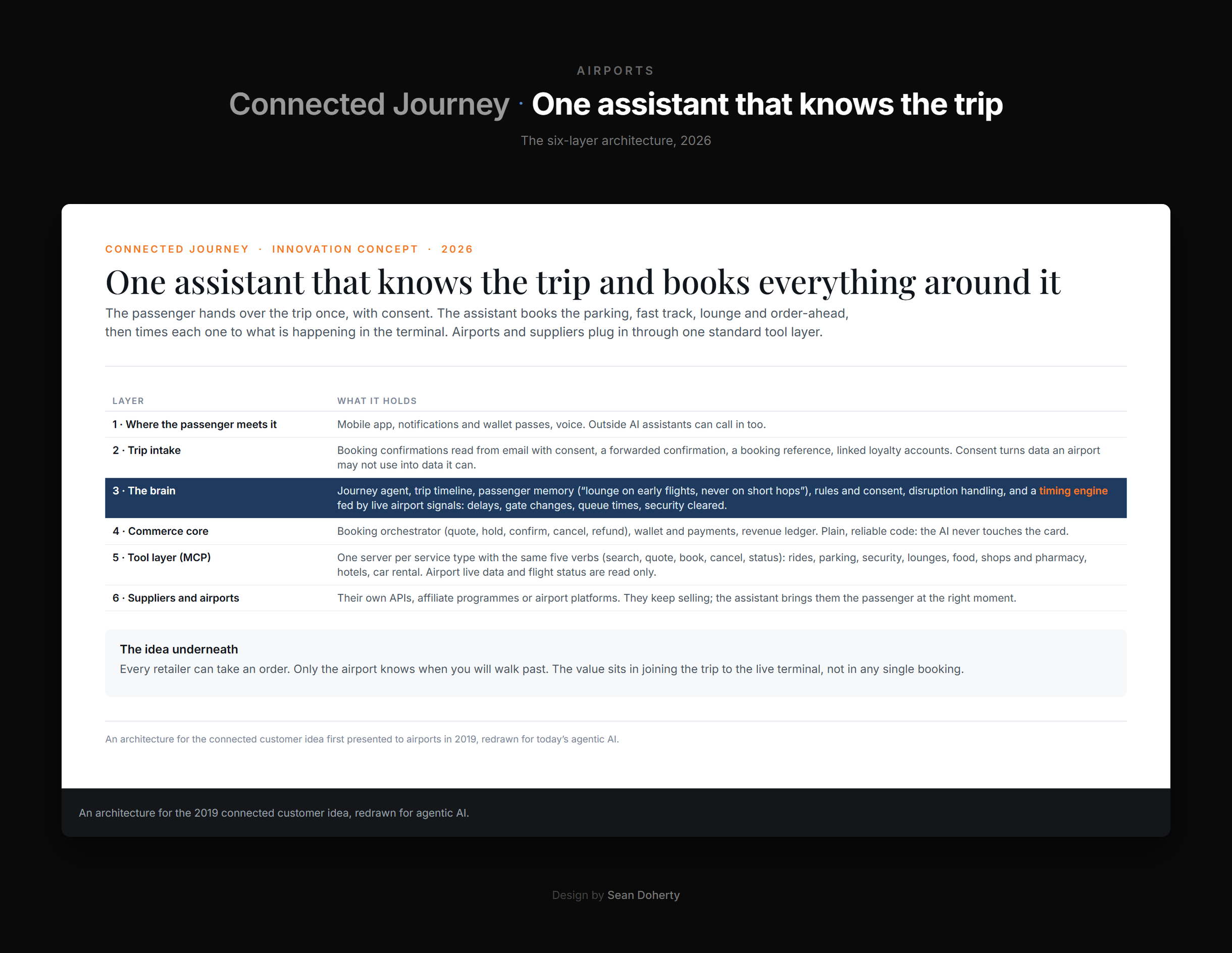
The architecture
Where the passenger meets it: app, wallet passes, voice, and outside AI assistants calling in.
Trip intake: confirmations read from email with consent, forwarded, or entered as a booking reference.
The brain: journey agent, trip timeline, passenger memory, rules and consent, disruption handling, and a timing engine fed by live signals such as delays, gate changes, queue times and security cleared.
Commerce core: a booking orchestrator that quotes, holds, confirms, cancels and refunds, with payments and a revenue ledger. The AI never touches the card.
Tool layer: one MCP server per service type, all with the same verbs, over each supplier's own API.
Suppliers and airports: they keep selling; the assistant brings them the passenger at the right moment.
Where MCP belongs
Inside: every supplier behind the same tools, so a new airport means new adapters, never a new agent.
Outside: our own MCP server, so general assistants can call the service for the airport part of a trip, turning a threat into a channel.
Not for payments: the agent searches and quotes; plain code books and charges once.
Status
Innovation concept, 2026. Orlando already sells reserved parking and a timed security lane, which shows the airport side of this exists today. It continues the connected customer work in case 42.
Project Artifacts
Project Details
Industry
Airports
Duration
2026
Team Size
1
Direct Reports
0
Scale
Concept
Scope
Global
Budget
Undisclosed
Platforms
Mobile, voice, AI agents, Model Context Protocol
Regulatory
Moderate
Engagement
Innovation concept