
DriveTech VR
VR driver training and insurance assessment concept for DriveTech — making driver training affordable for UK young people while giving insurers real driving data instead of crude demographic pricing.
Duration
1M
Team
1
Scale
POC
Scope
United Kingdom
Overview
A proof of concept developed for DriveTech addressing a real problem in the UK: learning to drive is prohibitively expensive. Driving lessons cost £25–£40 per hour, the average learner needs 45+ hours of practice, and the test itself has a 50% fail rate — meaning many young people delay getting their licence well into their careers simply because they can't afford it.
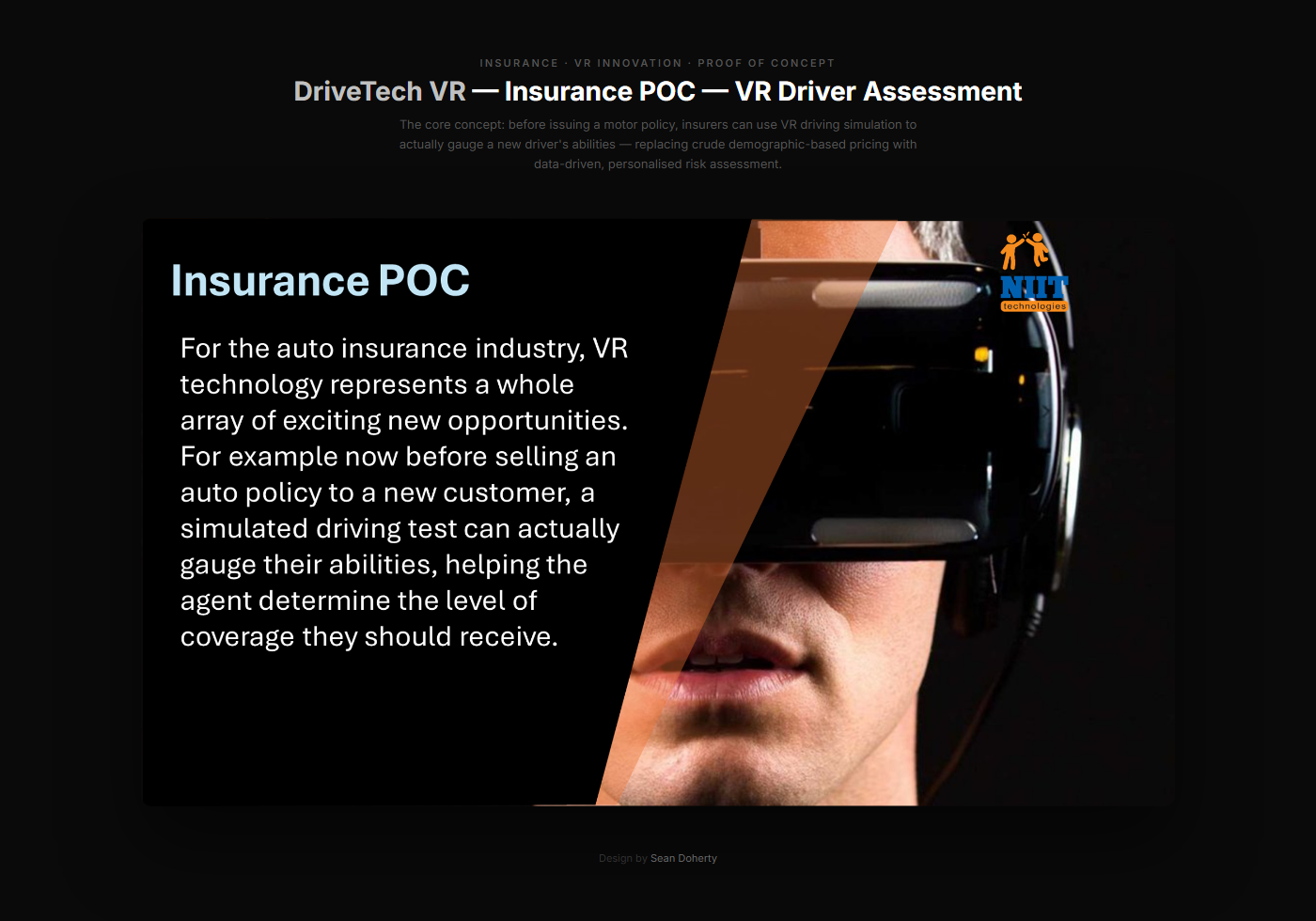
This concept proposed a two-sided VR platform that solves the problem for both young drivers and insurance companies simultaneously. Learners practise at home using affordable consumer VR headsets, building skills and confidence in realistic simulated environments. Their training data flows to insurers, who can assess actual driving ability rather than lumping all 17-year-olds into the same high-risk pricing tier.
Challenge
UK driving lessons average £25–£40 per hour, with most learners needing 45+ hours — putting the total cost between £1,125 and £1,800 before even taking the test.
Insurance premiums for young drivers are astronomical — often £2,000–£3,000 per year — because insurers have no data on individual ability and price purely on age and demographics.
Traditional driver training offers no data exchange with insurers, meaning a skilled young driver pays the same premium as a reckless one.
The 50% test failure rate means many learners pay for training twice, compounding the cost barrier.
Research & Discovery
Analysed the UK driving education market, establishing the cost barriers that prevent or delay young people from learning to drive.
Researched how motor insurers calculate premiums for new drivers, identifying the data gap between actual driving ability and demographic-based pricing.
Evaluated consumer VR headset capabilities for driving simulation fidelity, confirming that PlayStation VR, HTC Vive, and Oculus Rift could deliver realistic training scenarios.
Studied the regulatory landscape for sharing VR training data between education providers and insurance underwriters.
Solution & Deliverables
At-Home VR Training: Learners download the driving programme and practise on consumer VR headsets at home — realistic road scenarios, junctions, roundabouts, motorway driving, and parking — at a fraction of the cost of in-car lessons.
Hazard Experience Training: VR safely places learners in dangerous scenarios — drink driving consequences, texting while driving, sudden pedestrian crossings, adverse weather — letting them experience the consequences without real-world risk.
Live Instructor Support: Qualified driving instructors can join learners in the virtual environment to provide real-time guidance, answer questions, and assess progress.
Cloud Data Platform: Real-time performance data from every practice session is transmitted to the cloud, building a comprehensive driving profile over time.
Certified Testing Centres: Physical locations where learners take supervised VR driving exams under controlled conditions. Centre scores combine with at-home practice data to give insurers a complete picture.
Insurance Data Exchange: Learners can opt to share their VR training profile with insurers, who use the data to calculate personalised premiums based on demonstrated ability rather than age alone — rewarding good drivers with lower costs from day one.
Results & Impact
The concept demonstrated a viable path to reducing UK driver training costs by 60–70% through VR supplementation of traditional lessons.
Insurance companies gained access to actual driving performance data for the first time, enabling personalised premium calculation that rewards skill over demographics.
The two-sided model created new revenue streams for insurers (paid training modules, certified testing fees) while delivering genuine value to young drivers.
The concept remains commercially viable — consumer VR hardware has only become more affordable and capable since this was developed, and the UK young driver cost problem has only gotten worse.
Project Artifacts
Project Details
Industry
Insurance
Duration
1M
Team Size
1
Direct Reports
0
Scale
POC
Scope
United Kingdom
Budget
<5K
Platforms
VR Headsets (PlayStation VR, HTC Vive, Meta Quest), Web, Testing Centres
Regulatory
Moderate
Engagement
Innovation Concept