
NHS England, International GP Recruitment
Consulted on the candidate portal and tracker for a programme recruiting two thousand GPs into English practices: one secure record per candidate across five international agencies, four regions and the central team, in place of three spreadsheets emailed every week.
Duration
Sep 2018
Team
5
Scale
National
Scope
England
Overview
NHS England's International GP Recruitment programme, run through the North of England Commissioning Support unit, was recruiting two thousand qualified doctors from the European Economic Area and beyond into general practice across England by 2020. Every candidate's journey, from first interest abroad to a start in an English practice, was tracked in Microsoft Excel: a supplier template returned weekly by five international recruitment agencies, a regional template returned weekly by four English regions, and a central tracker into which the programme team re-keyed both to produce its weekly reports. In September 2018 the programme went to market for an online system to replace it, and I led the solution design and the proposal.
What the programme needed
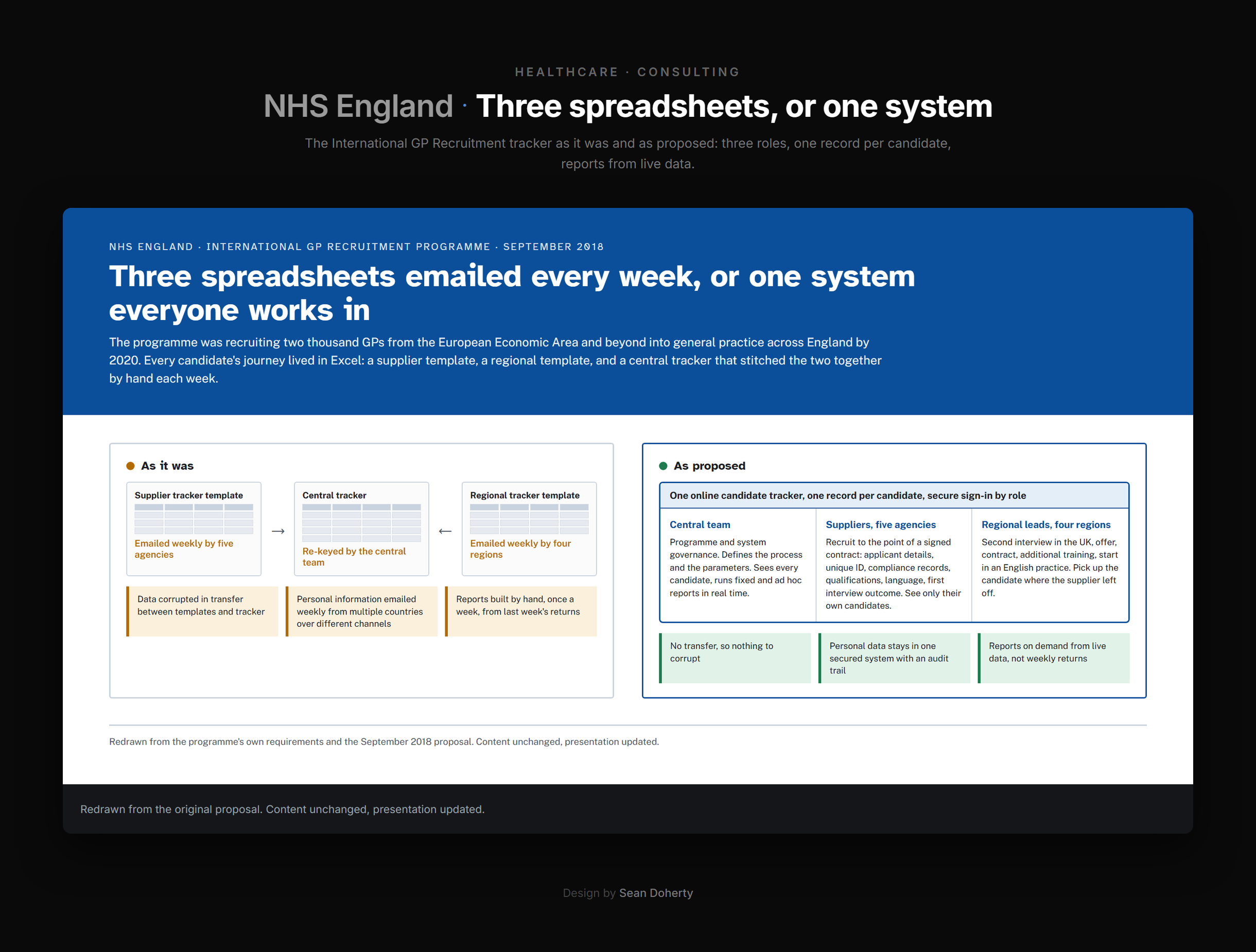
The requirements had been elicited by the programme's own business analyst through workshops with the three stakeholder groups, and they were clear about the risks of the status quo: data corrupted in transfer between the templates and the tracker, personal information about doctors emailed weekly from multiple countries over different channels, and reporting that was a week old on the day it was produced. Several detailed reports were still to be identified. The to-be system was an online database with secure, collaborative working for people in different countries, real-time reports on demand, and a front end that gave each group only what its responsibilities required.
The solution
One record per candidate, held once, with role-based access. Suppliers see and record their own candidates through the supplier phase: application and unique ID, compliance and mandatory records, qualifications, language skills, first interview outcome. Regional leads pick the candidate up at the UK handover and carry them through second interview, offer, contract, additional training and placement. The central team sees the whole pipeline, sets the parameters, and runs fixed and ad hoc reports from live data. The journey map on this page, one journey, two phases, three owners, is the structure the screens were to be built around, and it made the handover between an agency abroad and a region in England visible for the first time.
The approach
Six months in three phases. A one-month discovery phase with a workshop to finalise the business, technical, functional and non-functional requirements, a solution architect drafting the implementation architecture, and user stories written for planning. A one-month UX and design phase with a second workshop to define the three user profiles and their content needs, then information architecture, wireframes for desktop, tablet and mobile, and design concepts for approval. Four months of iterative development with two show and tell reviews, then testing, training and launch, with project management throughout. The design phase ran on the six-step framework used across my practice: discover, strategy, design, implement, measure, optimise. The experience carried in came from the Adecco candidate platforms, where tracking applicants across brands and countries was the daily problem, and the proposal offered a virtual assistant for candidate and HR enquiries drawn from the Adecco assistants.
Status
Proposed in September 2018 and presented to the programme team. The tracker was not commissioned from us. The work is shown here because the problem, a candidate journey that crosses organisations and countries and has to be held as one record, is the shape of most recruitment and healthcare workforce systems, and the solution design and plan stand on their own.
Why it matters
Healthcare workforce programmes are logistics problems with people's futures inside them. The design decision that mattered was not a screen; it was that a regional lead in Manchester should open a record and see everything an agency in Lisbon had recorded, without anyone emailing a spreadsheet.
Project Artifacts
Project Details
Industry
Healthcare
Duration
Sep 2018
Team Size
5
Direct Reports
2
Scale
National
Scope
England
Budget
Undisclosed
Platforms
Web, responsive, secure role-based portal
Regulatory
Heavy
Engagement
Consulting: solution design and proposal for a candidate portal and tracker