
Adecco
The 2017 global CMS assessment that took a seventy-site Sitecore estate from four to five month lead times to a two-tier operating model on a monthly release cycle, and the consolidation to four brands on one platform that followed.
Duration
2017 to 2018
Team
8
Scale
Global Enterprise
Scope
Global
Overview
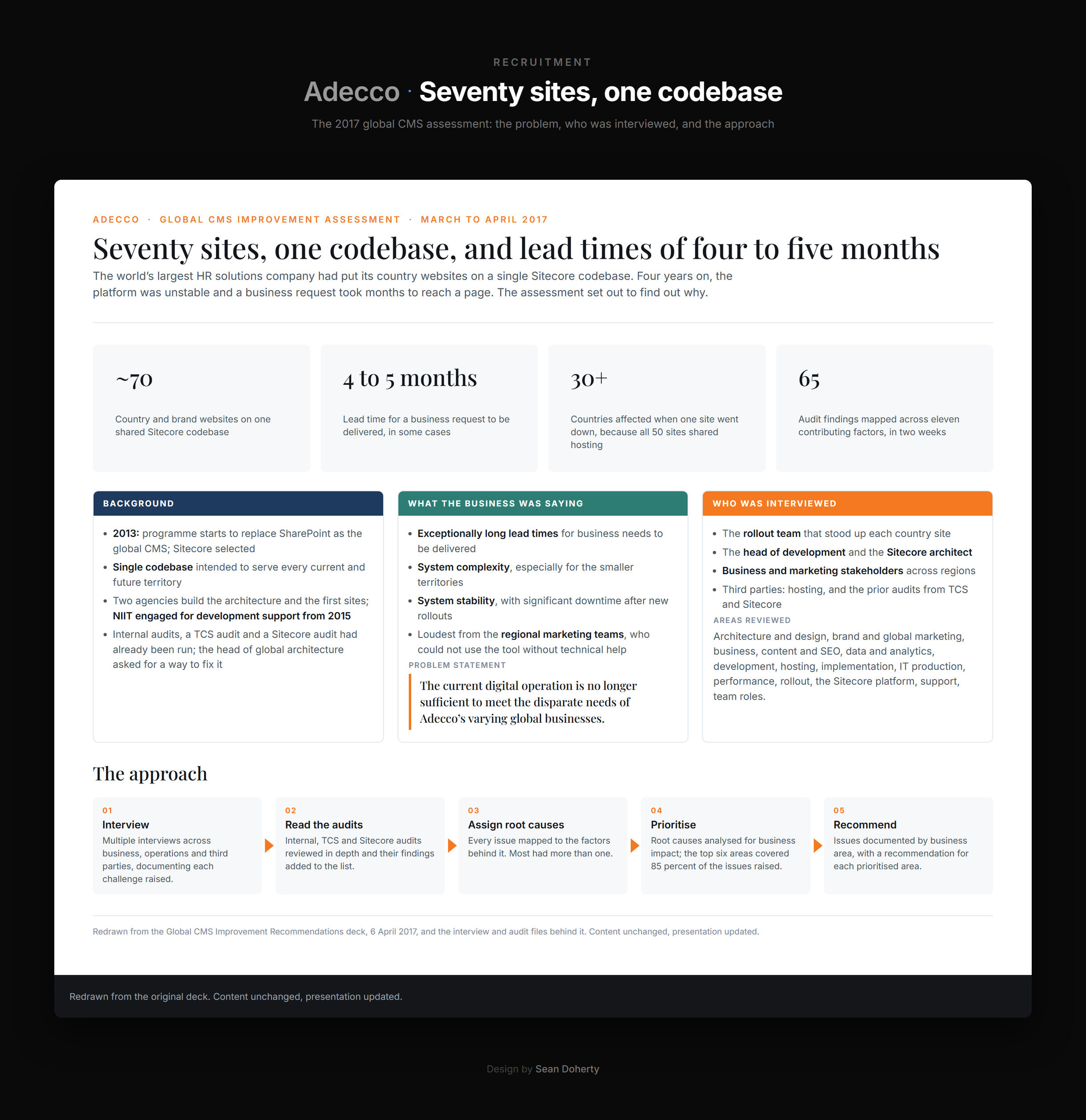
Adecco Group, the world's largest HR solutions company, had put roughly seventy country and brand websites onto a single Sitecore codebase. By early 2017 the platform was unstable, a request from a regional marketing team could take four to five months to reach a page, and an outage on one site took the other forty nine with it across more than thirty countries. Internal audits, a TCS audit and a Sitecore audit had already been run. The head of global architecture asked for a way to fix it, and I led the assessment.
What I did
Two weeks. Interviews with the rollout team, the head of development, the Sitecore architect and business and marketing stakeholders across the regions, alongside a close reading of the three earlier audits. Sixty five findings, each mapped to the factors behind it across eleven areas: platform, implementation and optimisation, integration, configuration, training, development practice, design, content, planning, process and governance, communication, and team structure. Then a prioritisation: the top six areas covered 85 percent of what had been raised. I wrote the problem statement and presented the recommendations on 6 April 2017.
The finding
The platform was not the problem. The root causes sat in planning, process and governance, development practice, the way Sitecore had been implemented and configured, and training. Content managers were editing markup to style a page. The Page Editor and A/B testing had been made unusable by architectural choices. There was no transparent prioritisation for local markets and no joint steering committee between IT and marketing. As I put it in the room: a lot of people wanted to make this a technical discussion, and it was not really a technical discussion.
The recommendation
Stop treating seventy businesses as one customer. A two-tier operating model: the largest territories, the United States, France and the United Kingdom, with dedicated senior Sitecore squads, their own sprint planning and a shared component library; the remaining forty five on a templated implementation with three to five layouts, front-end editing switched on and a training base, so they could change copy and imagery without a developer. Both tiers on a monthly release cycle, taking time to market to one month. A pilot in a separate environment with a select group of smaller businesses first, then scale. Alongside it: SLAs and a named owner for hosting, an administrator monitoring the environments, a move towards cloud, and standardised tagging on every site so the analytics conversation could become objective.
What followed
The model was adopted and the programme ran through to completion: the estate was consolidated to four brands on one Sitecore platform. The work continued into the 2018 managed-service model for the new global brand websites on Sitecore 8 and 9 on Azure, with a platform experience management team, scrum teams and regional liaisons, which is the operating model in practice. LHH, the career transition brand, had its SEO-led redesign scoped in the same period.
Why it matters
A house of brands on one owner does not need one website. It needs distinct brands on shared rails, and a release cadence set by the operating model rather than by the platform. That is what this assessment gave Adecco, and it is the shape most multi-brand estates still need.
Project Artifacts
Project Details
Industry
Recruitment
Duration
2017 to 2018
Team Size
8
Direct Reports
3
Scale
Global Enterprise
Scope
Global
Budget
Undisclosed
Platforms
Web, Sitecore, Azure
Regulatory
Moderate
Engagement
Platform assessment, operating model design and programme recommendation