
Alzheimer's Society
Innovation concepts built on participation rather than care: virtual reality for reminiscence, a contribution route for people living with dementia, and a natural language assistant for carers.
Duration
2017 to 2018
Team
8
Scale
Enterprise
Scope
United Kingdom
Overview
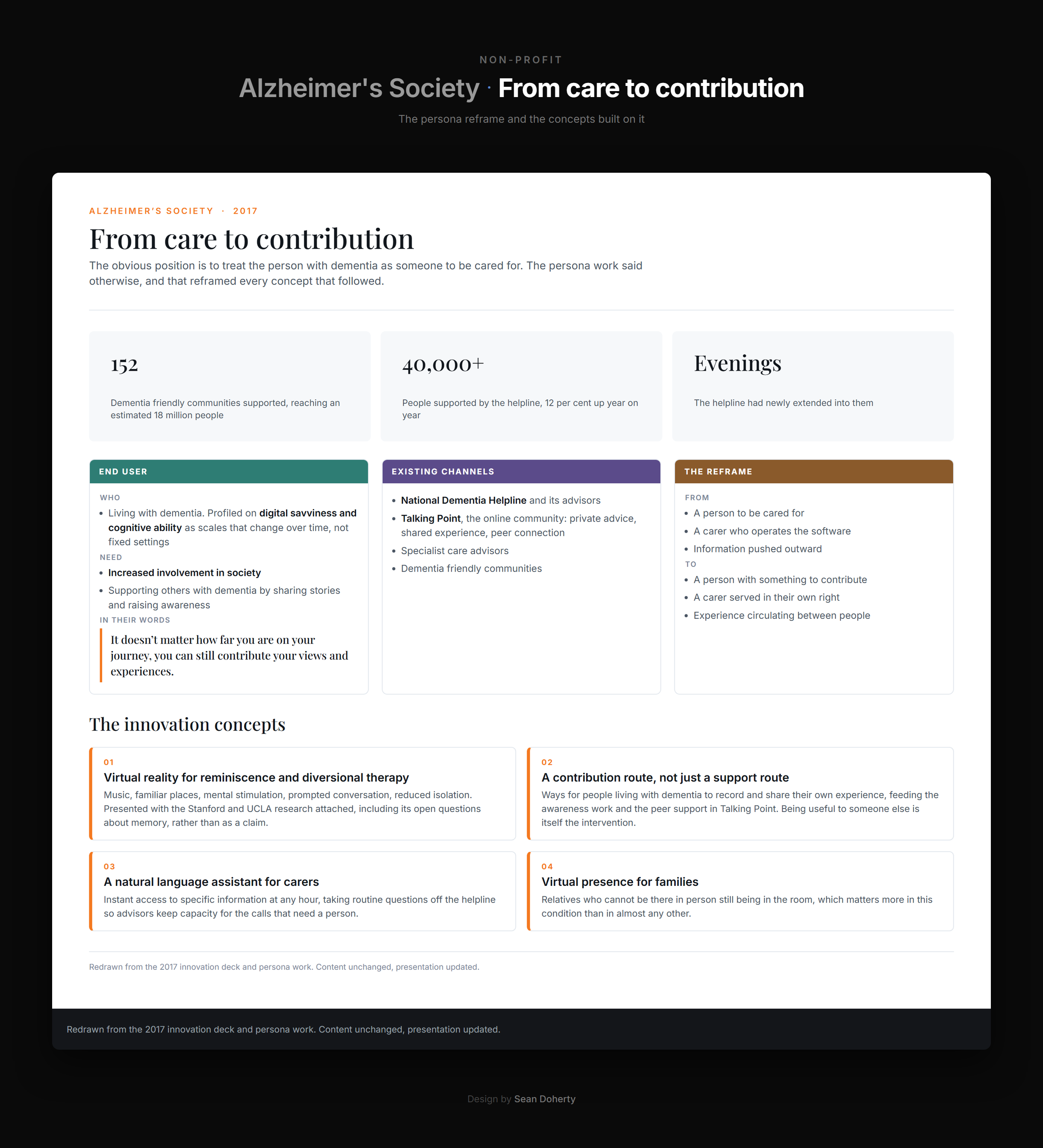
The obvious position for a dementia charity is to treat the person with dementia as someone to be cared for, and the carer as the one who uses the software. The persona work said otherwise.
The needs that came back were increased involvement in society, and supporting other people with dementia by sharing stories and raising awareness. One line carried the whole strand: it doesn't matter how far you are on your journey, you can still contribute your views and experiences. That reframed the brief from care to participation.
The Society's own figures set the baseline: 152 dementia friendly communities reaching an estimated 18 million people, and a helpline that had extended into the evenings and supported over 40,000 people, 12 per cent more than the year before.
The innovation concepts
**Virtual reality for reminiscence and diversional therapy.
### Music, familiar places, mental stimulation, prompted conversation and reduced isolation. Presented with the research attached rather than as a claim
Stanford work finding that virtual experiences changed real world behaviour after the headset came off, and UCLA work finding that the brain region responding to a virtual environment differs from the one responding to the real world, which raises open questions about memory that a dementia charity has to ask before anyone else does.
**A contribution route, not just a support route.*
Digital ways for people living with dementia to record and share their own experience, feeding the awareness work and the peer support in Talking Point. Being useful to someone else is itself the intervention.
**A natural language assistant for carers.*
Instant access to specific information at any hour, taking routine questions off the National Dementia Helpline so advisors keep their capacity for the calls that need a person.
**Virtual presence for families.*
Relatives who cannot be there in person still being in the room, which matters more in this condition than in almost any other.
Why it mattered
This carried forward into a 2018 innovation stream on disability and assistive technology, alongside digital assistants for independent living and a neural network application helping visually impaired passengers find a train door, which was built as a working proof of concept.
Project Artifacts
Project Details
Industry
Non-Profit
Duration
2017 to 2018
Team Size
8
Direct Reports
3
Scale
Enterprise
Scope
United Kingdom
Budget
Undisclosed
Platforms
Web, Mobile and Native: iOS and Android, VR, Conversational
Regulatory
Heavy
Engagement
Digital innovation concepts, user research and experience design