
Sophia AI, Elder Care Companion
Conversational AI companion for a senior healthcare startup, helping aging adults live independently with medication reminders, health tracking, wellness guidance, and safe human escalation, designed privacy-first and HIPAA aware.
Duration
6 months
Team
1
Scale
Innovation POC
Scope
United States
Overview
Sophia AI is a conversational AI companion designed for a senior healthcare startup, built to help aging adults live independently for longer. Many older adults live alone yet struggle with medication management, health tracking, loneliness, and unfamiliar technology. Sophia was designed to feel like a familiar friend rather than a device, delivering reminders, emotional support, and wellness guidance in a natural, human way, while staying privacy-first and compliant with healthcare standards such as HIPAA and GDPR.
As Head of Innovation, owned the product design end to end: discovery and research, personas and journey mapping, interaction and conversation design, accessibility, and the trust and escalation patterns that make an AI companion safe for a vulnerable population.
The Problem
Aging adults face daily friction with medication adherence, health tracking, and technology that was not built for them.
Loneliness and isolation are serious health risks for seniors living alone, and most tools address logistics rather than connection.
Caregivers and families carry a heavy, invisible load of routine check-ins, reminders, and worry.
Any system touching senior health data has to be private and compliant by design, not as an afterthought.
Research and Discovery
Built personas and a representative day-in-the-life journey for Dorothy, a 77-year-old living independently, mapping morning to night so every design decision was grounded in real moments of daily life.
Ran usability testing with older adults across a range of abilities and comfort with technology, to make sure the companion was genuinely accessible rather than compliant only on paper.
Led stakeholder workshops to align the team on privacy-first and compassionate design principles before a single screen was built.
The Design
Designed a voice-first companion accessible across tablets, smart speakers, and mobile, so seniors could interact in the way most natural to them.
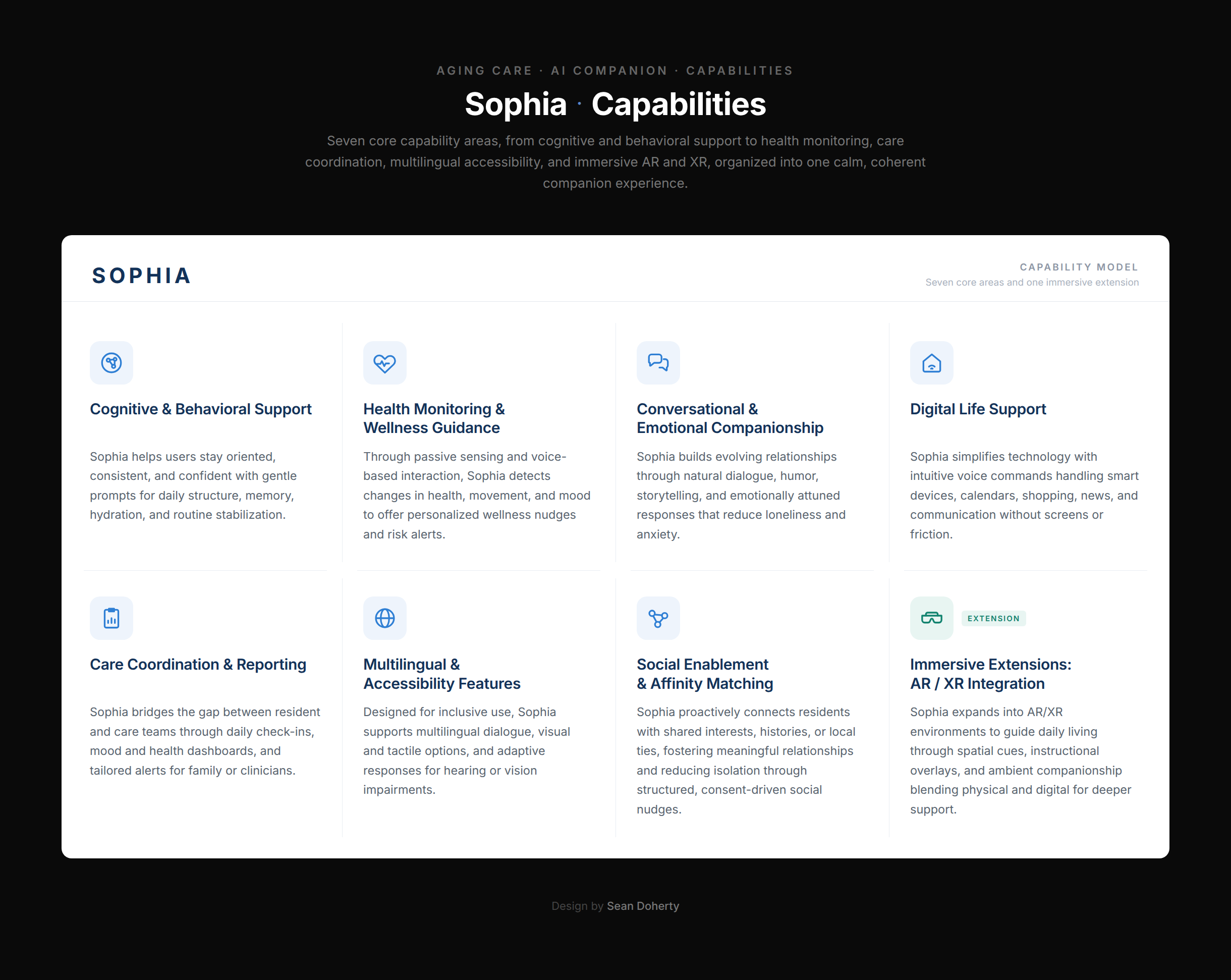
Organized seven core capability areas, including cognitive support, health monitoring, care coordination, multilingual accessibility, and reminders, into a calm, coherent experience rather than a feature dump.
Defined the trust and escalation model: how Sophia recognizes when a situation needs a human and hands off safely to caregivers or family rather than continuing alone. This human-in-the-loop pattern is the difference between a helpful companion and a risky one.
Designed family and caregiver visibility so loved ones stay informed and reassured without surveilling the senior.
Held the experience to WCAG 2.0 AA and built in multilingual support for diverse cognitive abilities and backgrounds.
Results and Impact
Reduced caregiver load by automating a large share of routine wellness checks and reminders.
In pilot feedback, seniors reported feeling less alone and more in control, and family members reported higher trust in the system.
Demonstrated a privacy-first, escalation-aware model for AI in aging care, validated through pilot studies focused on behavioral change and perceived well-being.
Project Artifacts
Project Details
Industry
Healthcare (Aging Care)
Duration
6 months
Team Size
1
Scale
Innovation POC
Scope
United States
Platforms
Web, Mobile, Voice
Regulatory
High (HIPAA, GDPR)
Engagement
Head of Innovation, Product Design