
Avios, Digital Target Operating Model
Digital target operating model for IAG's loyalty business: six end-to-end product squads, a rapid prototyping fast track, a continuous delivery track and weekly releases with features live but hidden, presented to the Avios leadership team in February 2018.
Duration
2 months
Team
2
Scale
Enterprise
Scope
United Kingdom
Overview
Avios is the loyalty currency of International Airlines Group, earned and spent across British Airways, Iberia, Aer Lingus and a network of retail, hotel and travel partners. In late 2017 its digital leadership wanted to move from an application organisation to a product organisation, release more often than monthly, and work in an explicitly Spotify-style culture. I was asked to design the digital target operating model and present it at the Avios Innovation Day on 1 February 2018 to the Chief Digital Officer, the Senior Delivery Manager, the Head of Emergent Technology and the Head of Digital Integration.
What Avios asked for
Their own framing, from the scoping meetings: a clear strategy for each customer segment; simpler integration for loyalty partners, from small partners who should plug in seamlessly to large ones needing deeper integration; an omni-channel customer experience across web, mobile, contact centre and partner channels; speed and agility, moving from a monthly release cycle toward deployment on demand; a product focus rather than an application focus, in line with the direction across IAG; and an experimental delivery model with a cultural change behind it.
The framing
The model starts from alignment and autonomy. Leaders focus on what problems need to be solved and let the teams decide how to solve them. High alignment with low autonomy is micromanagement. High autonomy with low alignment produces a Frankenstein of parts that do not fit. The target is both: loosely coupled, tightly aligned squads, agile coaches rather than scrum masters, failure treated as recovery rather than something to avoid, and impact valued over velocity.
The operating model
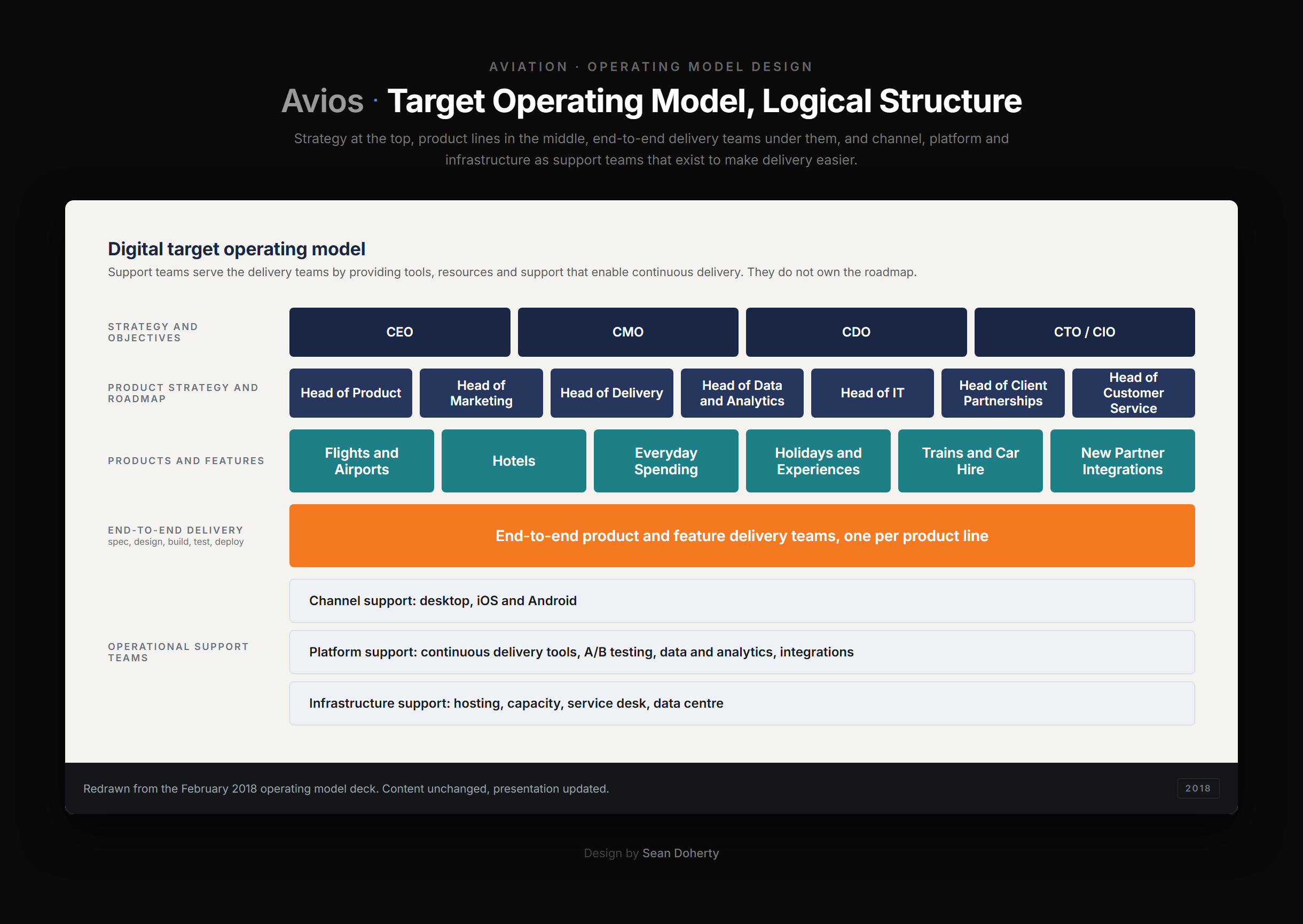
Strategy and objectives set by the executive team; product strategy and roadmap owned by the heads of product, marketing, delivery, data and analytics, IT, client partnerships and customer service.
Six product lines, each with its own end-to-end squad: Flights and Airports, Hotels, Everyday Spending, Holidays and Experiences, Trains and Car Hire, and New Partner Integrations.
Every squad carries the same six roles: an agile coach, a business analyst, UX and UI, a designer, front and back-end developers, and test and release. Each squad is responsible for research, design, development, testing, deployment, maintenance and operations for its product line, and decides what to build and how, guided by the company mission and product strategy.
Channel support for desktop, iOS and Android, a platform team for continuous delivery tooling, A/B testing, data and analytics, integrations, monitoring and training, and infrastructure support for hosting, capacity and the service desk. These are support teams. They exist to make delivery easier and they do not own the roadmap.
How work moves
Strategy to backlog. Senior management sets the vision, each business unit defines and prioritises its initiatives, three programme portfolio managers combine them into one roadmap with dependencies mapped, the units approve it, and agreed initiatives land in unit backlogs for squads to draw from.
A rapid prototyping fast track. A squad takes a problem statement through requirements, UX and UI, design and a working prototype as one loop. The business evaluates the prototype and approves it for development, sends it back, or shelves it. Approved work goes through development, automated testing and UAT against a defined DONE commitment.
A continuous delivery track for business-as-usual work, with UX and UI at the front of the pipeline to define the work properly, sprint work staged until a testing window opens, and automation in the testing phases.
Decoupled, small, frequent releases. Squads ship to a shared code base on a weekly train. A finished feature goes live hidden and is switched on when the business is ready, so no squad waits on another.
The design decision
The January draft cut the squads by customer journey stage: shopping online, flights, at the airport, hotels, holidays and experiences. The February version presented to the leadership team cut them by product line. The squad composition, the shared code base, the release model and the fast track were constant across both. What changed was what a squad is accountable for.
Status
The model was presented on 1 February 2018 as the proposed target state for the Avios digital organisation. The diagrams shown here are redrawn from the decks I authored for that day; the content is unchanged. Related delivery models from the same period were developed for British Airways digital services, DB Systel's mobile factory and Adecco's global platform team.
Project Artifacts
Project Details
Industry
Loyalty
Duration
2 months
Team Size
2
Direct Reports
1
Scale
Enterprise
Scope
United Kingdom
Budget
<100K
Platforms
Delivery organisation, web, iOS and Android channels
Regulatory
Moderate
Engagement
Operating model design, delivery advisory, executive presentation